My lit review has been a haul. I’m enjoying the reading but somewhere along the way, my research became about competency-based education verses traditional assessment, and I lost sight of my favourite part of my project- digital portfolios. I begin my lit review by comparing the two pedagogies and then dive into how e-portfolios likes SpacesEDU can provide the tool necessary for successful implementation of competency (or standards-based) education. But this past weekend, I pushed ahead to my research on digital portfolios to make sure I had what I needed. And that’s when I found my article, “Directions for Research and Development on Electronic Portfolios” by Philip Abrami & Helen Barrett, published in the Canadian Journal of Learning and Technology in Fall 2005.
Abrami-Directions_for_research-libre.pdf

It was exactly what I needed to remind me what the end goal was for my project and why digital portfolios are such a valuable resource. Even though it was written 20 years ago, it provided a spark for my weary mind. Between this article and a book by Schimmer on planning for the standards-based classroom, I’ve had my Marie Kondo moment of the term. I discarded anything that didn’t bring me joy and focused on what does. Digital portfolios spark joy for me.
The gist of this article is that digital portfolios are awesome, which I already knew. Full disclosure: I may have read between the lines a little for this assessment! But when I consider that this article was written 20 years ago, and they didn’t even know that something like SpacesEDU was possible, I am impressed. I am also reminded about the slow pace of educational change. But as I read through the article, I was reminded of all the reasons why I am such a fan of digital portfolios, what they’ve done for my own pedagogy, and how the ideas in the article align with my own project. So essentially, this blog will be a discussion on the ways that Abrami & Barrett’s article “Directions for Research and Development on Electronic Portfolios” align with my own project, “Beyond Content: Cultivating the Curricular and Core Competencies with SpacesEDU”.
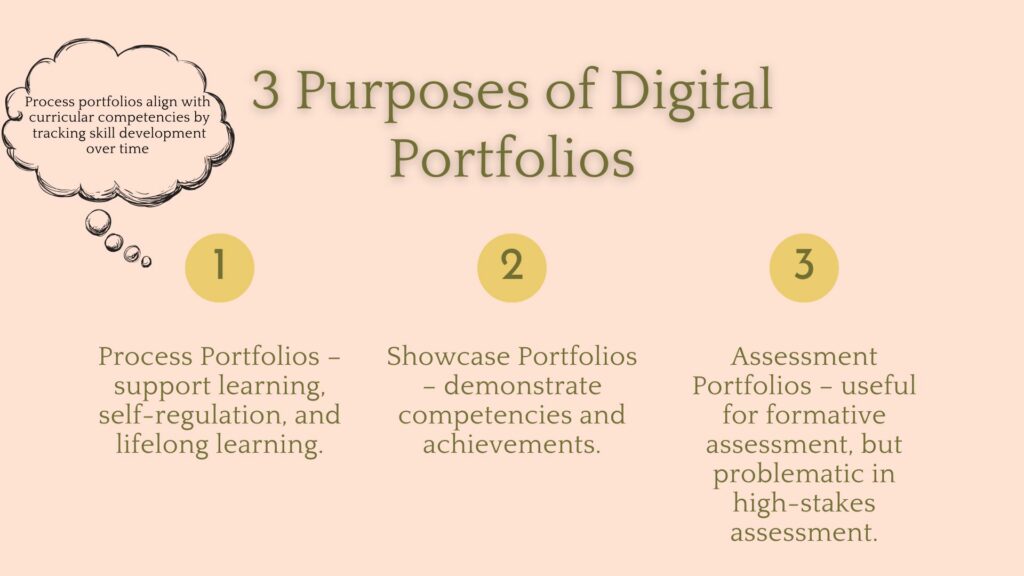
Abrami & Barrett emphasize that e-portfolios (which I will refer to as digital portfolios) are not just assessment tools but also powerful learning tools. The article first describes the different types of portfolios: process, showcase, and assessment. The balance of these intended uses of portfolios is what is important in my own pedagogy. I use SpacesEDU to meet all of these purposes. Process portfolios capture the process of learning, which directly connects to my thinking that portfolios show student learning over time and allow students (and teachers) to capture the “doing” aspects of the BC curriculum. The video, audio, and now drawing capabilities of these portfolios make them a valuable tool for assessing the learning itself, and not just the final project.
The second purpose of portfolios is to use them as a showcase of student learning. While traditionally portfolios have been used to capture best work, in my class we capture all work. This enables us to see the learning progression that happens and creates a transparent assessment system that involves student, teachers, and families. This is also how the showcase aspects of portfolio use is connected to the process aspects of portfolio use. In my class, students are also invited to share learning that happens outside of the classroom and offer it up for assessment. This supports the idea that portfolios should make thinking and learning visible. They also share aspects of their lives with our classroom community in the shared space.
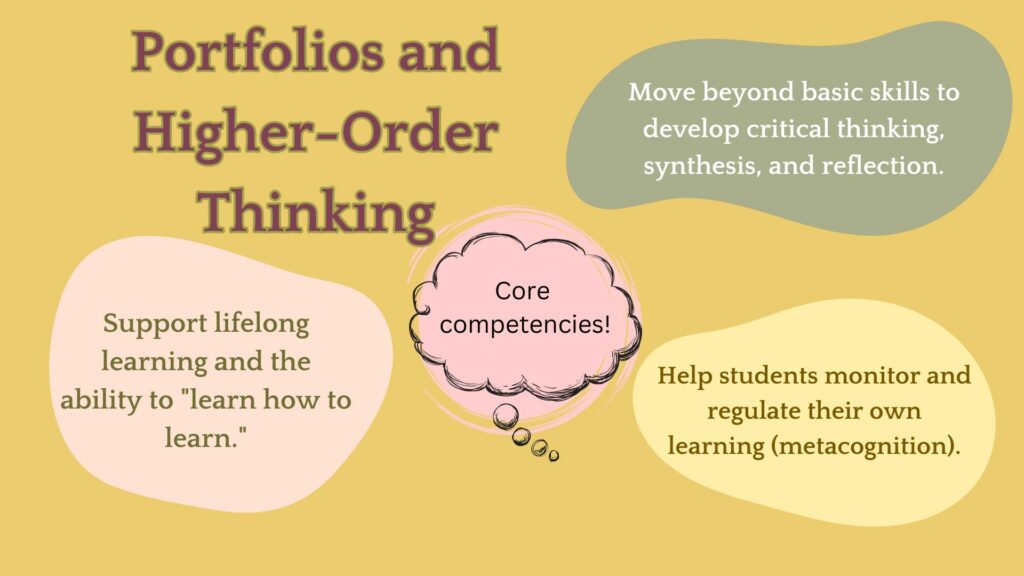
When students are able to showcase their learning in a multitude of ways, both process and product, they can then move into self-evaluation, self-reflection, and metacognition. Because I teach upper elementary, this is still a skill we are developing and often takes the form of responses to prompts or comments that I leave on their work. Though self-evaluation is not an assessed skill, it is one that is continuously worked on throughout the year and the benefit of this becomes more obvious after consistent practice. In the past couple of years, I have added a Core competency spaces for students to reflect on their learning throughout the term and replace the core competency self-evaluation students are required to do each assessment period. This ties into Abrami & Barrett’s final purpose of portfolios: assessment.
Digital portfolios can also be used for assessment. Since I use my portfolios to assess all student learning, I am supportive of this concept. SpacesEDU uses the competencies (curricular, content, and core) as the assessment method. Assessed work is on display. Abrami and Barrett argue that, “the use of portfolios in high stakes assessment of learning is problematic, while the use of portfolios in formative assessment of instruction or learning may be powerful.” (Abrami & Barrett, 2005) This is because “EPs may contain traditional forms of evidence but more often assessment portfolios contain complex evidence in a variety of forms and are, therefore, often associated with attempts at authentic assessment given that EPs allow for virtual demonstrations of competencies.” (Abrami & Barrett, 2005)
In terms of the intended outcomes for portfolio use, Abrami and Barrett “hope that the use of electronic portfolios encourages long-lasting impacts on learning and impacts which go beyond the acquisition of basic skills and the surface processing of information to the development of higher level thinking abilities, like synthesis, analysis, and evaluation, and the deep processing of information.” (Abrami & Barrett, 2005) You can imagine my job upon reading this as it so clearly matches my own thinking in regards to portfolios and supports the goals of the redesigned curriculum in BC.
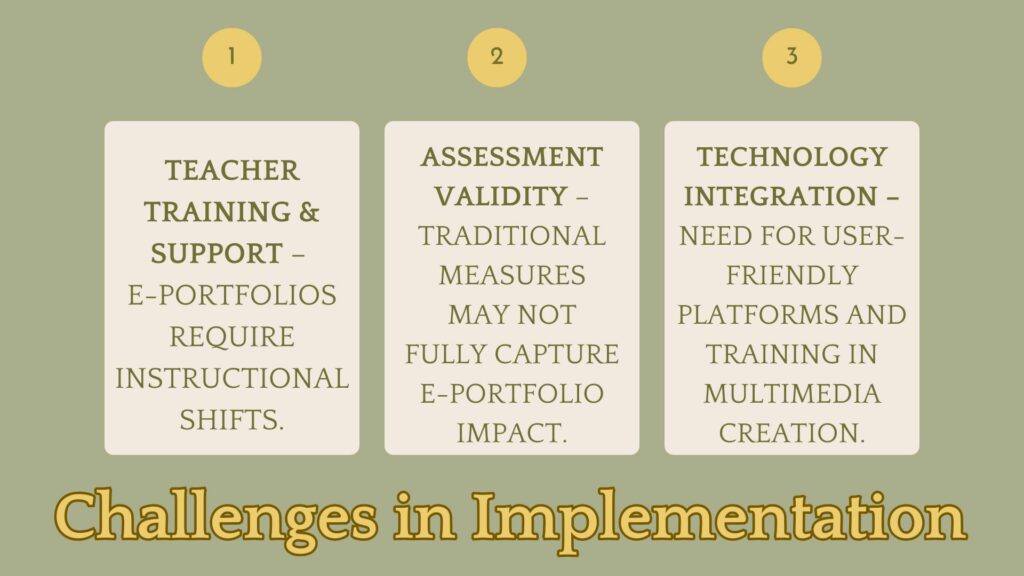
After discussing the types and purposes of electronic or digital portfolios, Abrami & Barrett then discuss the barriers to portfolio implementation, including technology barriers, assessment alignment, and teacher support and professional development. As this so perfectly aligns with my own project ideas, I was both heartened to see the thinking they’ve already done on this topic and dismayed that 20 years later we have the same issues.
The first barrier discussed is technology barriers. While I cannot imagine the technology barriers that may have existed 20 years ago for electronic portfolios (though I was in the classroom at the time), happily this is not the same issue today. “EPs take advantage of technology but are also bound by the limits of what technology can provide within the systems within which EPs operate.” (Abrami & Barrett, 2005) Platforms like FreshGrade and SpacesEDU have made it easy for teachers and students alike to manage their work in the digital space. If anything, the current barriers are more likely to be access to enough tablets or computers to make a digital platform easily accessible and parent use of the app.
The second barrier is assessment alignment and the process of balancing qualitative reflection with standardized evaluation. Assessment of student learning within portfolios might need to look different from traditional grading practices. The benefits of what can be assessed (the “doing” aspects of the curriculum) with portfolios is not something traditionally measured for assessment. Thankfully, with the implementation of the redesigned curriculum, there is far less reliance on standardized evaluation and the concept of qualitative reflection- for both student self-evaluation and teacher assessment- is distinctly supported. What could be seen as an issue for users of today’s digital portfolios is the replication of work. In my own practice, students receive much in the way of written and verbal feedback on their work within the SpacesEDU app; however, current reporting requirements means I am taking that feedback and individually adding it to student reports in a frustrating and time consuming process. This barrier will require support from the district. As noted in the article, “How do we encourage teacher, principal, administrator, technician, and policy-maker buy-in? In some cases, this top down support may mean showing how EPs support learning and curricular objectives, are cost and time efficient… and so on.” (Abrami & Barrett, 2005)
Finally, Abrami & Barrett look to the professional development and learning supports required to achieve portfolio implementation. This too is a focus on my own research and project. They discuss ways to support all stakeholders- students, teachers, parents, administration, and districts- in their shift to portfolio-based learning. They examine both the practicalities and the pedagogical shifts required to successfully use electronic portfolios in educational settings.
So, has 20 years of portfolio use changed the questions that Abrami and Barrett posed so long ago? Not really. They asked:
* How to best teach teachers and users of EPs?
*How do teaching practices change with the use of EPs?
*What form of technical training is necessary?
*How much technical skills training is needed in software use and in development of multimedia content (e.g., Digital photography, scanning, Quicktime videos, etc.)
*What about technology integration skills? And what form of pedagogical development is needed?
How should we teach and scaffold general principles of socio-constructivism and self-regulation? For example, teachers and users need to know:
• How, when, and why to use EP?
• Strategies, processes and outcomes of EP use and how to achieve them?
• Effective peer or student led conferencing: How to lead discussion (students)? How to guide and engage in discussion (parents)?
• In addition, there are questions about effective means of delivering training and professional development
• By insuring that EP is embedded in curriculum, not added-on?
• Using Swap and Share days and creating communities of practice?
• By helping form online communities and taking advantage of blogs/wikis
These questions are still being asked today, indeed within my own research. But perhaps I have a better idea now of how to frame my own learning. And maybe I feel a little more confident about the direction of my research knowing that great learners like Philip Abrami and Helen Barrett thought these things first.

References:
Abrami, P. C., & Barrett, H. (2005). Directions for research and development on electronic portfolios. Canadian Journal of Learning and Technology / La revue canadienne de l’apprentissage et de la technologie, 31(3). https://doi.org/10.21432/T2RK5K
Leave a Reply